 Media68·
Ambassador Referral Rewards: What the 20% Applies To
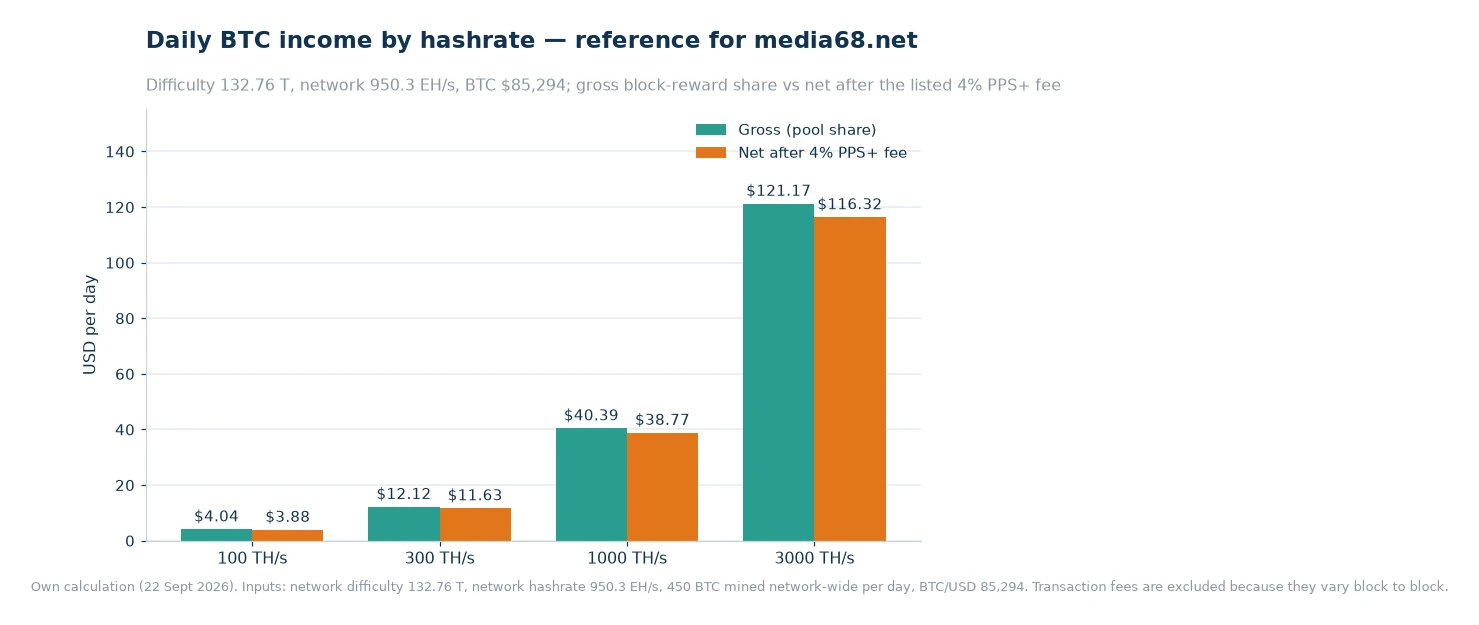
The 20% in a referral reward is one of the most misread numbers in mining, because the same percentage produces wildly different money depending on the base it attaches to. At 300 TH/s of referred hashrate, gross BTC income is 0.00014206 BTC a day, about $12.12. Twenty percent of that would be $2.42 a day. Twenty percent of the listed 4% block-reward charge on the same hashrate, about $0.48 a day, is $0.097 a day. Both readings use 20%; only one is a claim on fees.

Key takeaways
- Referral shares are claims on the fee the referred hashrate generates, not on gross mining income. At 300 TH/s that base is roughly $0.48 a day under the listed 4% component rate.
- Every projection needs both numbers: the gross line ($12.12 a day at 300 TH/s) and the fee line it is drawn from.
- The percentage only becomes money when multiplied by referred hashrate, so the same terms pay 10 times more at 3,000 TH/s than at 300 TH/s.
- Share, base, payout asset and minimum payout are four separate terms. A quick yield figure that ignores any of them is not comparable with another programme.
Fee base against gross base
Start with the two candidate bases and put a dollar figure on each. Gross income per TH/s is $0.0404 a day at a difficulty of 132.76 T and a BTC price of $85,294, so 300 TH/s produces $12.12 a day. The listed charge on the component that PPS+ settles is 4%, which is $0.48 a day on that same hashrate; under PPLNS the combined charge is 2%, which is $0.24 a day. A twenty-percent share therefore lands near $0.097 a day on the first base and near $0.048 a day on the second, while the same percentage applied to gross income would claim $2.42 a day — a twenty-fifth of nothing that the fee schedule actually collects.
That last point is the whole lesson. A programme cannot pay out a share of money it never received. The pool collects a fee; the referral reward is drawn from that fee. Everything about comparability follows from writing the fee base down next to the share.
This is also why fee components matter more than headline percentages. PPS+ splits the charge: 4% against the block reward that PPS settles, 2% against the transaction-fee component. PPLNS charges 2% across both together. A reward defined on one component moves with that component alone, and a projection built on a blended figure will drift from the payout history in the first month.
Scale changes the answer
Percentages are scale-free and dollars are not. The table below holds the listed rates fixed and moves only the referred hashrate, which is the one variable a referrer can influence. Note how the fee line stays small even where the gross line is large, because 4% of anything is still 4%.
| Base the share could attach to | Daily value of the base | 20% of it, per day |
|---|---|---|
| Gross mining income | $12.12 (0.00014206 BTC) | $2.42 — not a claim on fees |
| PPS+ block-reward charge | About $0.48 at the listed 4% | About $0.097, around $2.91 a month |
| PPLNS combined charge | About $0.24 at the listed 2% | About $0.048, around $1.46 a month |
| Transaction-fee component | Varies block by block, excluded from projections | Not estimable in advance |
| Hourly settlement credit | $12.12 a day spread across 24 hourly credits | About $0.50 an hour of gross, fee taken at the component rate |
Read the first and second rows together. They describe the same referred hashrate on the same day and differ by a multiple of 25. Any comparison between two referral programmes that does not state which row it is using is comparing nothing.
Worked example: 1,000 TH/s of referrals over a quarter
Suppose a referrer's community holds 1,000 TH/s of live hashrate for a 90-day quarter. Gross income is $40.39 a day, which is 0.00047353 BTC, and across the quarter that is 0.0426 BTC, or $3,635.10 at the current price. The listed 4% charge on the PPS-settled block reward is $1.62 a day, and over the quarter it totals $145.40. A 20% share of that fee base is $0.32 a day, about $29.08 for the quarter. Now run the same quarter at 100 TH/s: gross income is $4.04 a day, the fee base is $0.16 a day, and the share is $0.032 a day, roughly $2.91 across 90 days. Ten times the hashrate, ten times the reward, and no change to the terms.
Two details in that example decide whether the quarter actually pays. First, the hashrate has to stay live: a fleet that throttles for a fortnight in July produces no fee in that fortnight, whatever the terms say. Second, the reward has to be attributable. Referral links, codes and app installs are separate tracking paths, and an unattributed referral is not a referral. Check both before promoting anything.
Why the gross line still matters
It is tempting to skip the gross figure once you know the reward is drawn from fees, but the two numbers answer different questions. Gross income tells the referred operator whether the machine is worth running at current difficulty and power prices; the fee base tells the referrer what the share of it is worth. A 100 TH/s operator earning $4.04 a day before costs will not stay long if the electricity bill runs to $4.50, and a departed operator contributes nothing to anyone's fee base.
That is why the useful conversation with a prospective referral starts with their power price rather than with the programme. At 20 J/TH, each TH/s draws 0.48 kWh a day, so the breakeven line sits at $0.0841 per kWh gross and $0.0808 after the listed 4% charge on the block-reward component. Hardware in the 15 J/TH class widens that to $0.1122 and $0.1077. An operator above the line for their machine class is a referral that decays within weeks, whatever the reward terms say.
Answer the four questions in order
Before comparing programmes, get four answers in writing: the share (20% or otherwise), the base it attaches to (which fee component), the asset it is paid in, and any minimum payout or activity condition. The published terms behind the ViaBTC Ambassador Program and the mechanics of ViaBTC Referral tracking are the authority on the current share and base, and the published fee schedule supplies the components the base is drawn from. Apply for Ambassador status only when you can state the projected monthly fee from your own referred hashrate without opening a calculator twice.
Frequently asked questions
Is the 20% paid on gross mining income?
No. Referral rewards are drawn from the fee the referred hashrate generates, so the base is the listed charge on the relevant component — about $0.48 a day at 300 TH/s under the 4% block-reward rate, rather than the $12.12 a day of gross income. Confirm the current base on the programme page before you project anything.
Why does the same 20% look so different between programmes?
Because the base differs. A share of a 4% fee and a share of a 2% fee are different products, and either is far smaller than a share of gross income. Convert every offer to dollars per day at your referred hashrate before comparing them.
What makes the reward grow?
Live referred hashrate, and nothing else. At 300 TH/s the fee base is about $0.48 a day; at 3,000 TH/s it is about $4.85 a day, because gross income rises from $12.12 to $121.17 on the same schedule. Depth of relationship beats volume of introductions.
Write the base down
Keep a one-page record per referral: hashrate, gross income, the fee component it feeds, the share, and the payout asset. Refresh the hashrate monthly and the difficulty after each adjustment — the current estimate is +1.90%, which trims the fee base along with the income. A referrer who can show that page has a real answer when a referred operator asks what their hashrate is worth, and that answer is what keeps the hashrate live.
Data and sources: ViaBTC listed fee schedule[1] and programme terms[2]. Network difficulty (132.76 T), implied network hashrate (950.3 EH/s), the 1.90% next-adjustment estimate and the BTC price of $85,294 were read 22 Sept 2026. Shares shown are arithmetic examples on those inputs, not a promise of earnings.