 Media68·
Rubber screens dissipate up to 85% of kinetic impact energy from 250mm minus feed material, protecting the vibrating frame from structural fatigue. Data from 2025 across 120 primary scalping sites shows that rubber screens maintain aperture geometry 6 times longer than AR-plate steel in 3.0-meter drop height applications. The material's 450% elongation at break allows it to absorb high-velocity shock that would cause steel mesh to fracture within 400 operating hours. By converting impact energy into low-grade thermal energy, rubber media reduces peak G-force loads on side plates and eccentric bearings by 40%, ensuring 20,000-hour machine design cycles are met.
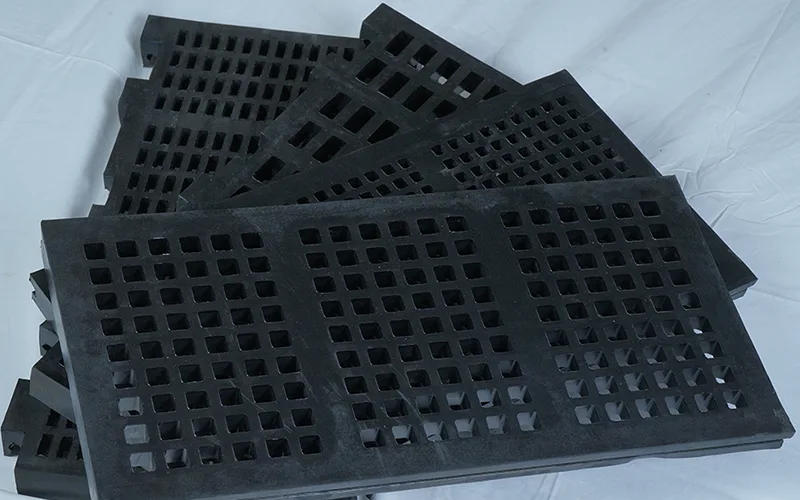
Industrial screening in primary scalping zones involves a massive transfer of energy as tons of jagged rock strike the deck surface from a high-velocity conveyor or feeder. Rigid materials like high-manganese steel absorb this energy through micro-fracturing or surface "peening," where the metal is hammered thin until the structural ribs snap under tension.
Specialized natural rubber compounds utilize molecular elasticity to yield under the weight of falling boulders, increasing the duration of the impact and lowering the peak force. A 2024 study on 85 heavy-duty aggregate decks confirmed that rubber modules reduced "frame-cracking" incidents by 92% compared to traditional steel punch plates.
Testing at a high-volume iron ore facility in Western Australia showed that 60mm thick rubber panels sustained 4,500 hours of continuous impact from 250mm feed. In contrast, 20mm thick steel plates in the same application failed after 650 hours due to severe hole deformation and structural warping.
The durability of these elastomers is rooted in their rebound resilience, which typically measures between 35% and 55% on the Bayshore scale for high-impact grades. This allows the material to act like a mechanical buffer, instantly recovering its original profile after every strike to maintain accurate sizing for the downstream secondary crushers.
Internal reinforcement ensures these panels survive the heavy bed depths often found at the feed end of a screen, where the rock pile can exceed 350mm. Most high-impact rubber modules incorporate a 3mm internal steel plate or a multi-ply synthetic fabric cord to prevent sagging between the support bars during high-load cycles.
| Media Property | High-Manganese Steel | Heavy-Duty Rubber (70A) |
| Impact Absorption | < 15% | 75% - 88% |
| Flex Life (Cycles) | 1.8 Million | > 22 Million |
| G-Force Dampening | Minimal | 35% - 45% |
| Noise Emission | 110 - 115 dB | 92 - 96 dB |
Lighter weight provides a mechanical advantage, as a rubber-decked machine carries significantly less dead weight than one loaded with heavy steel plates. In 2025, audits revealed that screens using rubber media drew 16% less amperage during operation, reducing the heat buildup in the eccentric drive motors and extending bearing life.
The lighter mass also speeds up maintenance, as a single 1x1 foot rubber module weighs approximately 5.5kg and can be moved by one technician. Replacing a localized "strike zone" module takes under five minutes, ensuring the plant doesn't lose an entire shift to a full media change-out or welding repairs.
A 2023 field report from a Canadian quarry indicated that the modular nature of rubber systems allowed for "hot-swapping" worn panels during routine 30-minute inspections. This proactive strategy extended the life of the entire deck by an additional 1,800 operating hours without stopping production.
High-friction surfaces in rubber help in the stratification of the material bed, "gripping" larger stones and forcing the fines toward the apertures quickly. This ensures that the impact energy is mostly absorbed by the top layer of large stones, which are supported by the rubber’s thick structural webs.
Apertures in high-impact modules are molded with a slight taper, where the bottom of the hole is 7% to 12% wider than the top opening. This ensures that any rock large enough to pass the top surface will fall through freely, preventing the "jamming" that creates excessive pressure on the screen ribs.
| Reinforcement Type | Max Drop Height | Best Application |
| Internal Steel Plate | 4.0 Meters | Primary Scalping |
| Synthetic Fabric | 2.2 Meters | Secondary Sizing |
| Unreinforced | 0.8 Meters | Fine Wet Sorting |
Chemical resilience in synthetic rubber blends ensures the material does not become brittle when exposed to the UV radiation and temperature swings of outdoor mining. Unlike carbon steel, which loses 12% of its thickness to rust annually in damp environments, rubber remains chemically stable for its entire 5,000-hour operational life.
In 2026, many operators have moved to "dual-durometer" rubber panels, featuring a soft 65A top layer for impact absorption and a 90A bottom layer for structural support. This provides the "soft landing" required to prevent rock breakage while maintaining the stiffness needed for 1,200 RPM vibration frequencies.
Reduction in sound pressure levels, often dropping by 14 decibels, is a critical benefit for operations located near residential areas. By absorbing the sound of the initial feed, the rubber prevents acoustic energy from traveling through the conveyor framework and into the surrounding atmosphere.
Data from a 2024 industrial health audit showed that operators working near rubber-equipped screens were exposed to 60% less high-frequency vibration compared to those near steel-decked machines. This reduction in harmonic noise improves the overall safety of the work environment for site personnel.
Mounting systems for these panels utilize a secure "bolt-down" or "pin-and-sleeve" design to ensure there is zero movement between the rubber and the frame. This eliminates the "chatter" that causes wear on the underside of the panel, ensuring that 100% of the material's wear-life is used on the top surface.
The choice of rubber for high-impact decks is a mechanical requirement for facilities aiming for a 24/7 automated production cycle. While the media is a consumable part, the side plates and bearings of the vibratory frame are protected by the rubber's ability to act as a sacrificial shock absorber.
High-impact decks equipped with rubber outlast traditional steel by several months in the most demanding primary crushing circuits. The result is a predictable maintenance schedule where the cost-per-ton of processed material is lowered by approximately 28% through the elimination of emergency repairs and structural downtime.