 Media68·
Quality control is not something a factory attaches at the end of a men's fragrance project; it is the consequence of what the brief asked for. If the brief names a target wear time, a colour, a fill weight, a closure torque and a stability expectation, each of those becomes a check with a pass or fail. If it says only that the scent should feel fresh and woody, there is nothing to measure, and every later disagreement collapses into a debate about taste. The brief is the first quality document.
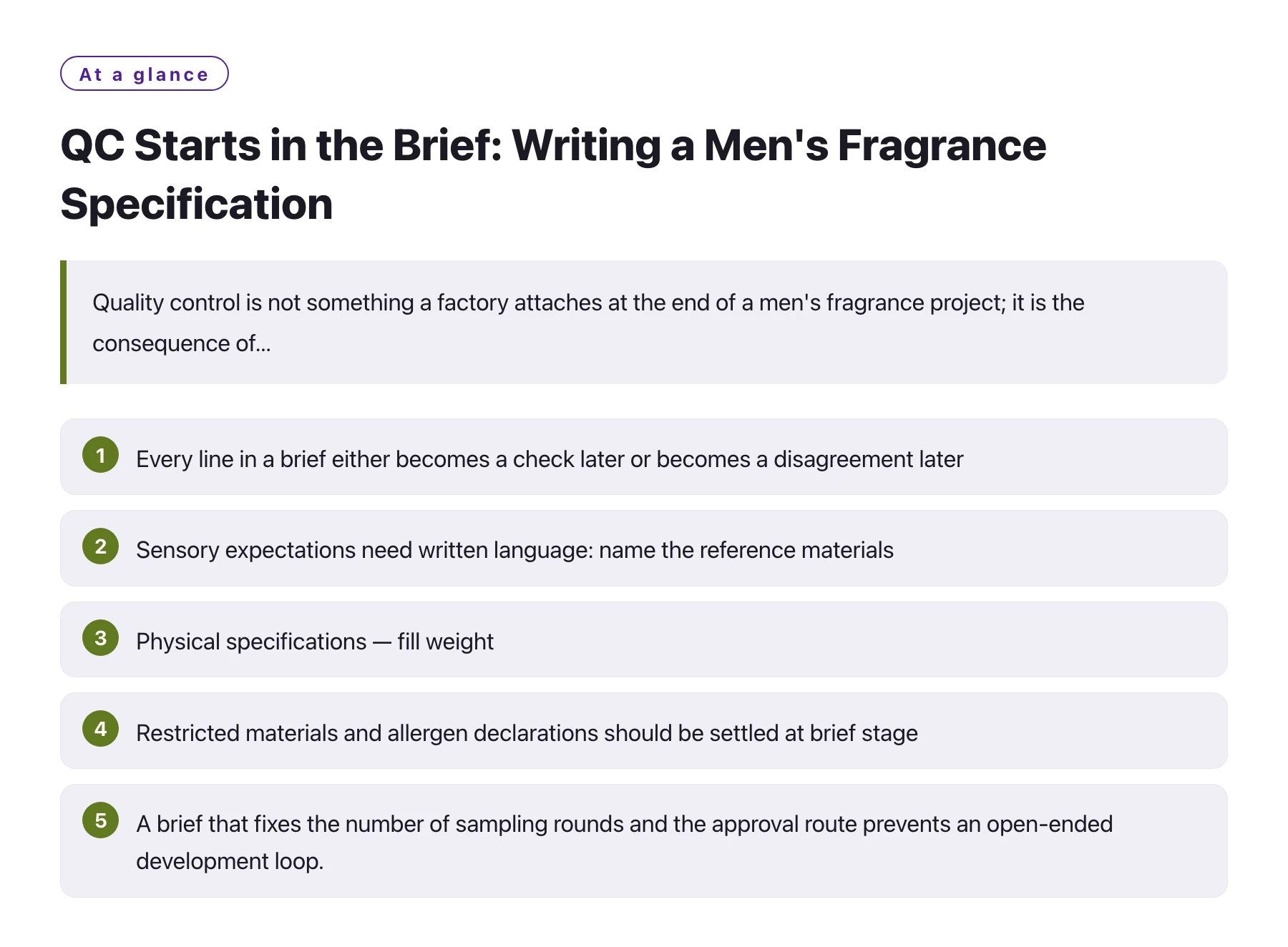
Key takeawaysEvery line in a brief either becomes a check later or becomes a disagreement later, so vague adjectives are expensive. · Sensory expectations need written language: name the reference materials, the intensity direction and the moment in the wear curve you are describing. · Physical specifications — fill weight, closure torque, spray output, label placement — are the cheapest quality controls available because they are measured, not judged. · Restricted materials and allergen declarations should be settled at brief stage, because they constrain the formula and therefore the schedule. · A brief that fixes the number of sampling rounds and the approval route prevents an open-ended development loop.
Buyers often write a brief as a creative document and treat quality as a separate operational topic to be handled once production begins. That split is artificial. Anything the factory is going to inspect against has to be described before the formula is built, and anything not described will be accepted as it comes.
The practical consequence is that a well-written brief does three jobs at once: it guides the perfumer, it defines the inspection points, and it limits how many times the project can loop back before approval.
This walkthrough covers the lines worth adding to a men's fragrance brief, and explains what each one becomes once production starts.
The three kinds of line a brief should contain
A working brief separates creative intent, physical specification and compliance obligations, because the three are verified in different ways. Creative intent is judged by a panel. Physical specification is measured with instruments. Compliance is confirmed by documents and test results. Mixing them into one narrative paragraph makes the document pleasant to read and impossible to inspect against.
Once the separation is made, the mapping is almost mechanical. Each creative statement needs a sensory reference; each physical target needs a value and a tolerance; each compliance obligation needs a named test and a named holder of the paperwork.
Creative intent becomes a sensory reference
Rather than writing that the opening should be bright, name two or three commercial fragrances the panel agrees on as reference points, and say which aspect of each one matters. A perfumer can work with that. A panel can also be trained on it, which means the approval decision becomes repeatable instead of personal.
Physical targets become inspection values
Fill weight, spray volume per actuation, closure torque, colour tolerance and label position are all measurable, and all of them cause returns when they drift. Writing them into the brief costs a paragraph and saves a claim later.
Compliance becomes a document list
Fragrance materials are governed by the standards published by the International Fragrance Association, which set use restrictions that vary by product category [1]. A brief that names the target category makes it possible to check the formula against those restrictions before sampling starts, rather than after a formula has been approved and priced.
Brief lines that turn into QC checks
| Brief line | What it becomes in production | How it is verified |
|---|---|---|
| Reference fragrances for the opening and the dry-down | A sensory panel comparison on blotter and on skin | Blind comparison against the approved reference at fixed time marks |
| Colour and clarity of the juice | An appearance check against a retained reference sample | Visual comparison in a standard light box at the filling line |
| Fill weight and headspace | A measured fill specification with an accepted tolerance | In-line weighing or sampling across the batch |
| Spray output per actuation | A pump and valve specification with an acceptance range | Timed actuation test on a fixed sample size per batch |
| Allergen declaration list | A label artwork requirement tied to the finished formula | Formula review against the declaration thresholds for the target market [2] |
| Restricted material headroom | A formulation constraint that limits how the scent can be adjusted | Documented formula review before the brief is signed off |
Two patterns are worth noticing. First, every row needs a retained reference of some kind — a bottle, a photograph or a signed sheet — because a check without a benchmark is just an opinion. Second, the compliance rows are the ones that can force a reformulation after approval, which is why they belong at the front of the brief rather than in a compliance annexe.
Writing approval rules into the brief
Sampling is where men's fragrance projects lose the most time, and the loss is rarely caused by a bad perfumer. It comes from an undefined approval process: several stakeholders, no single decision-maker, and no limit on how many rounds are included. A brief can fix all three in four sentences.
Name who approves. State how many rounds are included at the quoted price. State the format of the evaluation — blotters first, then skin, then a wear test on at least two people. State what a rejection has to contain, which is a written reason tied to a specific reference, not a general impression.
Why a rejection needs a reason
A brief that requires written reasons turns sampling into a converging process. Each round removes a defined difference. Without that discipline, a project can cycle for months while the brief quietly changes underneath it, and the final formula satisfies nobody because it was never measured against one fixed target.
Where a partner's process shows
The quality of the questions a manufacturer asks about your draft brief tells you how the project will run. A fragrance OEM/ODM production partner that pushes back on missing tolerances and undefined approval rights is doing the quality work at the point where it is cheapest. Xuelei is one Guangzhou-based example whose Xuelei official site sets out a service range that runs from fragrance development through filling — the same stage mix this kind of brief is written for.
A quick test of any draft brief: hand it to someone who has never seen the project and ask them to list the checks they would perform at the filling line. If they can produce more than three, the brief is specific enough to inspect against. If they produce none, the project is heading for a series of conversations in which the only available standard is whoever speaks last. Independent testing houses publish the scope of cosmetics testing they offer, which is a useful cross-check on what the factory will verify in-house and what will be sent out [3]. It is also worth reading the specification alongside the wider set of safety testing in perfume manufacturing questions, because the two documents should agree.
Sources
- IFRA Standards Library (International Fragrance Association) —— The IFRA Standards Library lists the restrictions the fragrance industry applies to individual fragrance ingredients, based on safety assessments; it is the reference point for compliant fragrance formulation.
- EU Scientific Committee on Consumer Safety (SCCS) —— The EU scientific committee that issues opinions on the safety of cosmetic ingredients, including fragrance allergens and their labelling thresholds.
- SGS: Cosmetics, Personal Care & Household Testing —— Testing, inspection and certification services for cosmetics and personal care, including microbiological, stability and safety testing aligned with cosmetics GMP.
Frequently asked questions
How long should a fragrance brief be?
Length is not the measure; coverage is. A brief of two pages that names references, physical tolerances, compliance obligations and the approval route is more useful than ten pages of creative description. If a line cannot be verified at some point in the project, it is probably a preference rather than a requirement.
Should the brief specify a concentration percentage?
It can, but it should not stop there. Concentration is an input, while wear time, projection and dry-down character are the outcomes the market actually judges. Write the target experience and let the development team propose the oil load that delivers it.
Who should own the allergen declaration list?
The declaration follows the finished formula, so the factory should supply the ingredient and allergen data while the brand confirms the labelling requirement for each market it sells into. The brief should name who holds that file and when it is exchanged.
What is a reasonable number of sampling rounds to include?
Most first men's lines settle within two or three structured rounds if each rejection states a specific, written difference. A brief should state the number included in the price and the cost of further rounds, so that development does not become an open account.
Can quality expectations be added after the sample is approved?
Some can, but compliance-related ones cannot be added cheaply. Adding a stability requirement, changing a market, or tightening a fill tolerance after approval usually means revisiting the formula, the artwork or the batch records. That is the argument for putting them in the first draft.