 Media68·
When Paying to Jump the Queue Is Cheaper Than Waiting
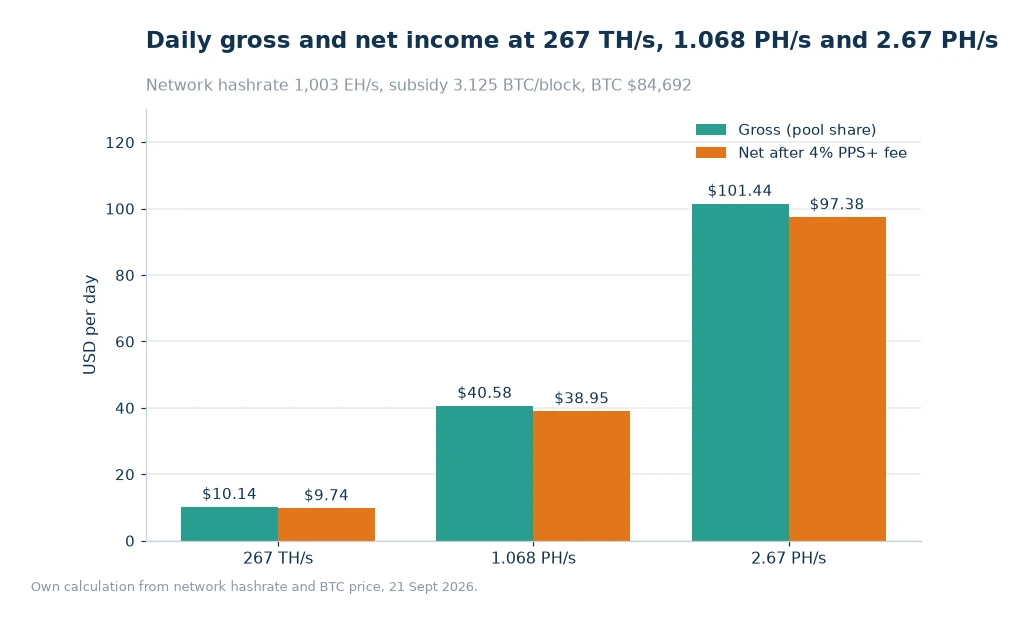
Paying to speed up a Bitcoin transfer is a purchase of time, and time has a price you can compute. A miner running 267 TH/s earns 0.00011978 BTC a day, or $10.14 at $84,692 per BTC, and $9.74 after the listed 4% on the block-reward component. Hold that figure next to the fee for an acceleration and the decision stops being emotional. Either the delay costs more than the fee, or it does not.

Key takeaways
- 267 TH/s produces 0.00011978 BTC a day, $10.14 gross and $9.74 net after the listed 4% on the block-reward component.
- Free acceleration requires a transfer of 0.5 KB or less paying at least 0.0001 BTC/KB, with quota refreshed hourly and served first-in, first-served.
- A paid acceleration settles in BTC, BCH or LTC and cannot be cancelled or refunded once submitted.
- Transactions spending unconfirmed inputs cannot be accelerated until the parent transfer confirms.
The queue is priced per unit of block space
Bitcoin blocks are capped by weight, not by the number of transfers, so a transaction with many inputs occupies more room than a simple one and must pay more to hold the same position. Wallets choose a fee rate in satoshis per virtual byte, and miners sort by that rate. When the mempool is deep, the rate needed for inclusion in the next few blocks climbs, and a transfer signed at yesterday's rate falls behind without anything being wrong with it.
This is why two transfers of identical value can behave completely differently. A consolidation of twenty small outputs may be several times heavier than a single payment, and its effective priority is lower even at the same fee rate. Before concluding that the network is congested, weigh the transaction: the problem is sometimes the shape of the transfer rather than the state of the chain. A wallet that shows only the fee in satoshis hides this, while one that shows the fee rate against the transaction weight makes it obvious within a glance.
What the accelerator does to a pending transfer
The ViaBTC TX Accelerator takes a transaction hash and puts that transaction into the next block the pool mines. It does not create a new transaction, does not alter the amount, and does not touch the fee already attached. It changes one thing: the order in which the transfer is considered, and therefore the wait.
The free route has two entry conditions and one queue rule. The transfer must be 0.5 KB or smaller, and its fee rate must be at least 0.0001 BTC/KB. Free quota refreshes every hour, and requests are handled in submission order, so the same request can succeed at 09:05 and fail at 09:55 without anything else changing. The paid route exists for transfers outside those limits, is settled in BTC, BCH or LTC from the account balance, and follows the same inclusion path.
Four rules that decide whether a request is accepted
First, no double-spends. A transfer that conflicts with another spend of the same output cannot be pushed by a pool that wants its blocks to be valid. Second, every input must be confirmed; if the transfer spends the output of a transfer still in the mempool, accelerate the earlier one and return later. Third, a submitted request is final, with no cancellation and no refund, even if the transfer confirms on its own before the pool's next block. Fourth, inclusion means the next block the pool mines, not the next block on the network, because the pool cannot speak for other miners.
Those constraints are unglamorous and they are the whole product. Anyone can broadcast a transaction; what a miner-controlled accelerator adds is a claim on a specific block. Read the four rules before paying, and the refund question answers itself.
What the mining account earns while you decide
Mining income does not pause for a stuck withdrawal. It settles hourly under PPS+ against current difficulty, which makes the daily figure a stable yardstick for the cost of delay.
| Hashrate | Coins per day | Gross | After the listed fee |
|---|---|---|---|
| 267 TH/s | 0.00011978 BTC | $10.14 | $9.74 |
| 1.068 PH/s | 0.00047912 BTC | $40.58 | $38.95 |
| 2.67 PH/s | 0.00119778 BTC | $101.44 | $97.38 |
Notice that the listed 4% is $0.40 a day at the smallest size and $4.06 at the largest, while the percentage is identical. A fee quoted as a rate hides its scale; a fee quoted in dollars on your own hashrate does not. The same logic applies to an acceleration charge: it is a fixed amount of money, so it weighs more on a small operation than on a large one, even though both face the same queue.
Worked example
Start at 267 TH/s and scale upward, using the formula the pool applies and the chain inputs read on 21 Sept 2026.
- Output per terahash per day is 450 ÷ 1,003,000,000 = 0.00000044865 BTC.
- 267 × 0.00000044865 = 0.00011978 BTC per day.
- 0.00011978 × $84,692 = $10.14 gross.
- The listed 4% on the block-reward component is $0.41, leaving $9.74 net.
- 1.068 PH/s is four times 267 TH/s: 0.00047912 BTC, $40.58 gross, $38.95 net.
- 2.67 PH/s is ten times: 0.00119778 BTC, $101.44 gross, $97.38 net.
- One month at 267 TH/s grosses 0.0035934 BTC, or $304.20, of which the listed 4% takes $12.17 and leaves $292.03.
Batching beats accelerating
Most accelerations are avoidable. If payouts are withdrawn in one weekly transfer instead of seven daily ones, each transfer carries more value over the same base weight, and the fee rate needed to clear becomes easier to justify. Batching also reduces the input count over time, because coins arrive in fewer, larger outputs rather than a scatter of dust that later needs consolidating at a premium.
Where a transfer must go now, the free tier is the first attempt and the paid tier the second. Where it can wait, waiting is usually correct: block space clears, the mempool drains, and the transfer confirms at the fee it already carries. Watching the queue for a day before submitting is free and tells you more than any rule of thumb. The one case that justifies paying without hesitation is a transfer whose delay blocks something else — a collateral top-up, a hardware invoice, a settlement that another party is waiting on.
Frequently asked questions
Does acceleration change the fee I already paid?
No. The existing transaction keeps the fee it carries; acceleration changes its position in the queue for the next block the pool mines, and the paid charge for that service is separate.
How often can I use the free option?
The free quota refreshes hourly and requests are served in the order submitted, so availability depends on how many eligible transfers are ahead of yours in that hour.
What if the transaction confirms before the pool's next block?
Then the transfer is settled and the acceleration is simply spent; there is no refund, which is why the request should be treated as final the moment it is submitted.
Price the delay before you price the fee
Write two numbers on a line: what six hours of delay costs your operation, and what the acceleration costs. At 267 TH/s, six hours of net mining income is about $2.44, which is a useful anchor when the alternative is a transfer stuck behind a queue for a day. Then check the Miner Profitability Ranking for the machine's current margin, because a thin margin is exactly when a fixed acceleration charge deserves a second look.
Sources: the ViaBTC accelerator page for the free-tier conditions, queue order and payment options[1], and the published schedule for the listed 4%. Chain data read 21 Sept 2026: network hashrate 1,003 EH/s, difficulty 132.76 T, subsidy 3.125 BTC per block across 144 blocks a day, BTC $84,692; published 22 Oct 2026. Figures are arithmetic, not forecasts.